Basement Leak Detection in Union, NJ
Discovering water in your basement is one of the most stressful experiences for a homeowner. In Union Township, where properties range from historic homes near Kean University to mid-century builds in Five Points, basement construction varies wildly. The biggest challenge isn't just cleaning up the water—it's accurately identifying where it came from in the first place.
Many homeowners immediately assume their foundation is failing, leading to expensive waterproofing quotes. However, a significant percentage of basement moisture issues are actually caused by concealed plumbing failures. Our basement leak detection Union NJ service is designed to definitively answer the most important question: Is this a plumbing leak, or is it groundwater intrusion?
Plumbing Failures vs. Groundwater
Because gravity pulls everything downward, the basement acts as the collection point for almost any leak in the house. Determining the source requires a careful process of elimination.
Internal Plumbing Sources
Water pooling near the center of the floor, spraying onto joists, or consistently dampening specific drywall sections in a finished basement often points to the home’s mechanical systems. Common culprits include:
- Supply Line Leaks: Copper pipes running along the basement ceiling or concealed within finished basement walls that have developed pinhole corrosion.
- Water Heater Failures: Aging tanks that are slowly weeping from the base, often hidden by utility closet doors or stored belongings.
- Drain and Sewer Line Issues: Backups from floor drains or leaks originating from the main cast iron sewer stack descending through the basement.
- Overhead Bathroom Leaks: A failed shower pan or toilet wax ring on the first floor that is dripping directly onto the basement ceiling.
External and Structural Sources
If the moisture is primarily entering where the floor meets the wall (the cove joint), seeping through foundation block cracks, or occurring exclusively during heavy New Jersey rainstorms, the issue is likely structural groundwater intrusion. Issues with exterior grading, failed sump pumps, or clogged gutters can severely impact the basement envelope.
Our Investigation Approach
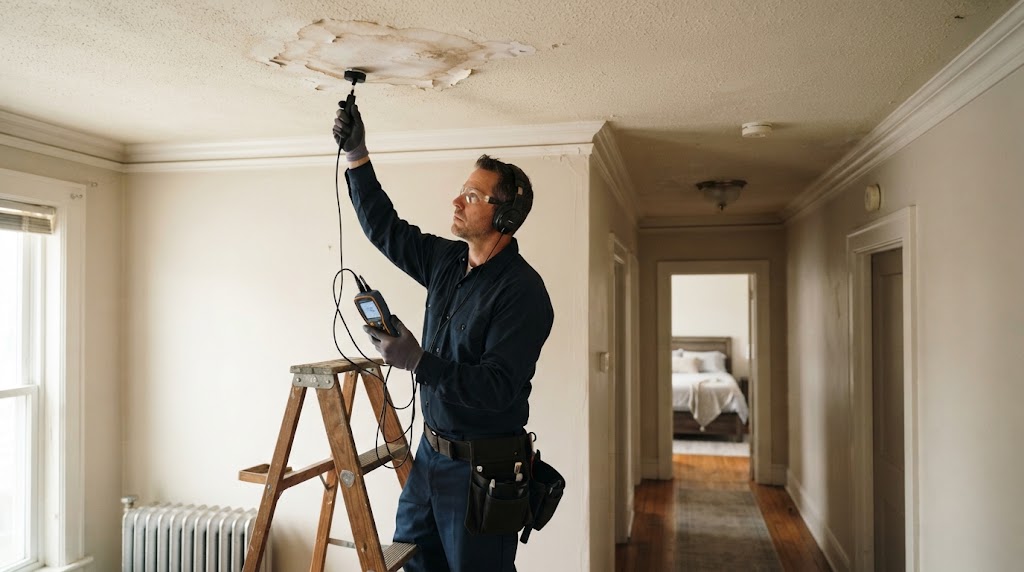
When you contact us for basement diagnostics, we systematically inspect your plumbing infrastructure. We utilize thermal imaging to trace moisture pathways behind drywall and acoustic listening equipment to detect pressurized leaks within supply lines. We evaluate the main water shut-off valve, the incoming service line, and overhead plumbing runs.
If we determine the issue is a failed pipe, we can proceed with targeted repairs. If our testing confirms your plumbing system is perfectly intact, you can confidently consult a structural waterproofing specialist knowing you aren't wasting money fixing the wrong problem.
Need to Find the Source of Basement Water?
Stop guessing whether you need a plumber or a foundation contractor. Let us perform a technical inspection to locate the exact origin of the moisture.
Call for Detection: (201) 510-1615